
Jellybean Planner
Jellybean ("JB") is an AI planning tool, that helps expressive arts (EXA) educators draft an intermodal workshop outline in a few minutes. Educators share the workshop length, their group, a theme and the arts modalities they'd like to use. JB returns a timed outline with gentle bridges that carry something from one modality into the next.
Jellybean was designed for EXA educators working toward or holding IEATA's REACE registration. It is grounded in IEATA's definition of intermodal expressive arts, stays firmly in non-clinical, educational territory, and runs on each person's own Claude account, so there are no API keys to manage.
Jellybean App built on Claude. Click the image above to try the prototype!
The design challenge
The hardest part of planning an intermodal workshop is the move between modalities. Picking a movement game and a collage activity is easy; making the shift from one to the other feel continuous, not fragmented, takes experience. New facilitators often end up with a list of crafts rather than one creative thread.
The tool also had to work for a wide range of groups, from kindergarten classrooms to adult community circles, and keep every activity playful and beginner friendly. And it had to feel calm to use. Educators often plan between sessions, tired, so the planning experience should model the same pacing and care they bring into the room.
Grounding in IEATA
Every structural choice in Jellybean maps to IEATA's own language, and the interface quotes IEATA directly wherever it names a modality.
Intermodal is the core. IEATA defines intermodal as "the process of interweaving and sequencing multiple expressive arts modalities," and calls it "essential to IEATA's definition of expressive arts" (IEATA Glossary). This is why JB's main job is the bridges, not the activity list.
Six modality families. IEATA lists "all forms of visual art, including photography and craft"; "movement/dance/somatics"; "voice, rhythm, sound, and music"; "drama and enactment"; "all forms of writing, including poetry and storytelling"; and "guided meditation, use of the imagination, and nature-based practices" (IEATA). The Flow screen is organised around these six, with IEATA's exact wording as each family's heading.
Sequenced or layered. IEATA notes that "two or more arts modalities are typically sequenced or layered" (IEATA). Educators choose Sequencing, Layering or Both, and JB writes the bridges accordingly.
Non-clinical by design. IEATA describes Expressive Arts Consultation, Education and Facilitation as intermodal work "in a non-clinical setting" that "may be therapeutic yet does not include diagnoses or treatment plans" (IEATA Glossary). JB is instructed never to diagnose, interpret a participant's artwork or feelings, or ask anyone to disclose painful experiences.
The starter activities inside each family are my own beginner-friendly suggestions, not an IEATA list, and the short tab names ("Visual art", "Imagination & nature") are shortened to fit a phone screen.
Session architecture and bridges
Every outline follows the session shape described by Knill, Levine and Levine (2005): opening the frame, art making and play, aesthetic response, harvesting, and closing. JB fills the middle with the educator's chosen modalities and writes a bridge for each shift between them.
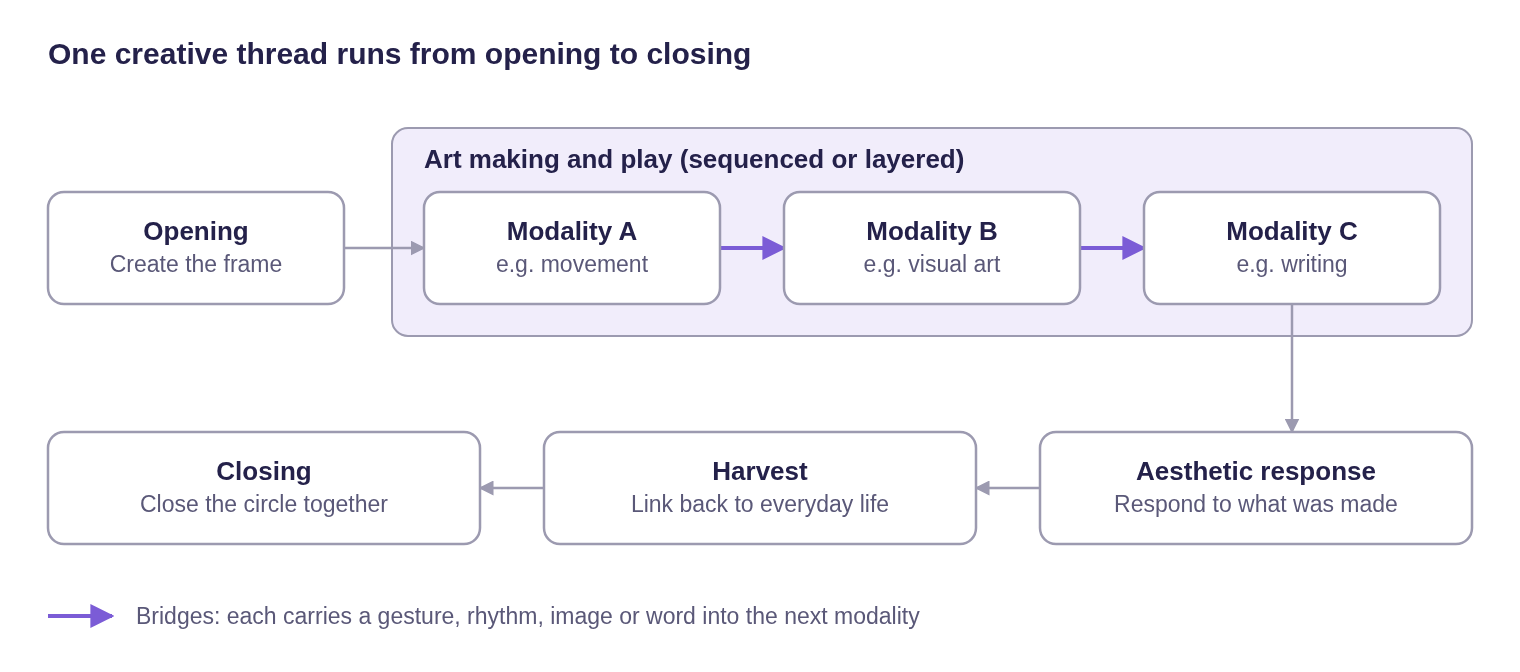
Workshop flow logic
A bridge carries something concrete from one modality into the next, such as a gesture that becomes a line on paper or marks that become words. That carried thread is what IEATA means by interweaving, and it is what keeps the session from feeling like a list of separate crafts.
Interaction design decisions
Jellybean borrows its pacing from meditation apps: one question per screen, soft pastel gradients, generous space and controls you can operate with a thumb.
One question per screen (duration, audience, theme, flow) keeps the load light and makes planning feel unhurried.
Sliders and chips instead of forms make selection quick and joyful, with typing always optional.
A filling ring for duration gives time the most visual weight, because it is the first constraint.
An "Intermodal shifts" stepper, capped by duration, prevents plans that switch modalities faster than a group can settle (about 12 minutes per activity).
A "Your flow" tray of numbered jellybeans shows the arc at a glance, and items reorder with up and down buttons that work on phones and with keyboards.
"Add your own" and "JB picks one" in every family offer guided options without closing the door on an educator's own ideas.
A gentle nudge when two neighbouring activities share a family encourages a fuller intermodal shift but never blocks the choice.
A breathing screen while JB writes turns waiting into a pause that mirrors the workshop itself.
Results shown as a river make activities pools and bridges streams, and each bridge can be rewritten on its own with "Try another bridge".
A sample workshop that needs no AI lets anyone, including portfolio visitors, see what JB makes.
Every screen is keyboard accessible, text meets contrast guidelines, and motion pauses for people who set their device to reduce motion.
The character: Jellybean
Jellybean is an original character designed in Adobe Illustrator by Dr. Sonia Tiwari. JB is a translucent cyan jelly with sparkling eyes, pink lips, four small legs and colorful beans floating inside. The beans are a quiet metaphor for the tool itself (“Spill the beans” as it says on the welcome page). Different modalities live together in one body, held in a shared medium.
The character went through three rounds. A 3D recreation with beans inside read as beans stuck to the surface and lost the character's colours. A simplified 3D bean body pinched at the centre and broke the mouth. The final version uses my own vector artwork, untouched, with animation layered on top:
eyes that follow the cursor or a finger and drift back to centre
random blinks every 3 to 6 seconds, with the occasional double blink
beans that drift in slow loops, masked so they never leave the body
a gentle breathing squish anchored at the feet
a soft wobble when tapped
The same Jellybean breathes on the waiting screen among slow glowing particles, so the pause while JB writes feels like part of the experience.
AI design and ethics
JB drafts and the educator decides. The outline is a starting point to adapt, never a script to follow.
No API keys. Most EXA educators I know do not have developer skills. Jellybean is published as a Claude artifact that asks Claude directly, and features that use Claude "count toward their own usage limits" for each viewer (Claude Help Center). Friends use their own accounts; no one pays for anyone else, and no key is stored anywhere.
The educator's ideas stay intact. Activities an educator adds are passed to JB exactly as typed and marked "keep it exactly as named."
Education, not therapy. Following IEATA's non-clinical framing, JB never diagnoses, interprets artwork or feelings, or asks for disclosure. Every invitation is optional, with an adaptation (seated, no touch, nonverbal, solo or partner).
Privacy. Workshop details go only to Claude to write the outline. Nothing is saved to a server, and one person's plans are never visible to another.
Honest limits. When Claude is unavailable, Jellybean says so plainly and offers the sample workshop instead of failing silently.
Process and iteration
Jellybean was designed and built in a single day of co-design with Claude, moving from IEATA informed guidance to a working tool.
Research. Read IEATA's definitions of intermodality, its modality list and the REACE non-clinical framing, plus Knill's session architecture.
Tool concept. Considered a rule-based bridge library I would write myself, then chose an AI planner so the ideas come from each educator's own inputs.
Interface on a design canvas. Eight phone screens in a calm, meditation-app style, reviewed before any code was written.
Character. Two 3D attempts, then my own SVG artwork animated directly.
Look and feel. Moved from sage and indigo to light pastels on soft gradients, using Jellybean's bean colours as accents.
IEATA alignment. Rebuilt the Flow screen around IEATA's six modality families, added Sequencing and Layering, and removed a phrase ("low skill, high sensitivity") that belongs to Knill's tradition rather than IEATA.
Access model. Moved from bring-your-own API key to each viewer's own Claude account, so non-technical educators can use it.
Working tool. Built as a single page with a sample workshop, tested end to end, and embedded on my portfolio.
Next Steps
Test outlines with EXA educator friends in real sessions and refine the starter activities in our shared voice.
Add a materials-on-hand filter, so JB plans around what a classroom already has.
Offer saved workshops and a printable one-page facilitator card.
Explore versions for specific settings, such as the garden recess art program, museums and family workshops.
References
International Expressive Arts Therapy Association (IEATA). Glossary of Common Terms. Definitions of expressive arts, intermodal, and Expressive Arts Consultation, Education & Facilitation.
International Expressive Arts Therapy Association (IEATA). What is Intermodal Expressive Arts? The six arts modalities; sequencing and layering; settings for REAT and REACE practice.
International Expressive Arts Therapy Association (IEATA). What We Do. Intermodality as "following a creative thread through many different art forms."
Knill, P. J., Levine, E. G., & Levine, S. K. (2005). Principles and Practice of Expressive Arts Therapy: Toward a Therapeutic Aesthetics. Jessica Kingsley Publishers. Session architecture: opening the frame, art making, aesthetic response, harvesting, closing (review summary).
Rogers, N. (1993). The Creative Connection: Expressive Arts as Healing. Science & Behavior Books. Sequencing from movement and sound into visual art and writing, as summarised by Riverbank Therapy.
Anthropic. Claude Help Center: publishing and embedding artifacts. Viewers' use of Claude counts toward their own usage limits.
