
MenoPaws
Go Team MenoPaws at Build For Her Hackathon at SF Tech Week 10/10/26!
MenoPaws is a place for women’s health education, self-advocacy and community building around perimenopause and menopause. It was created in one day at Build For Her, a women's health hackathon during SF Tech Week 2026, by a team of five talented women and a cute, fictional, menopausal cat named Paws.
Who it is for - Women with lived experience of perimenopause and menopause who feel dismissed by the people meant to help them: told they are too young, that it is "just stress", or that their labs look normal.
What it offers - Paws, a menopausal cat in a pink beret, helps you with four things:
Health education - briefly explains perimenopause and menopause in plain language, with practical steps you can start now
Guided reflection - gathers your story in your own words through a structured interview, asking the questions a menopause specialist typically would
Self-advocacy - prepares an editable summary to take to your appointment, along with a personal toolkit and helplines
Research data - If you consent, adds your de-identified answers to an open research dataset, so many stories can become evidence for future research
Why it matters - Perimenopause (which includes menopause) is common, long and often missed. Individual stories are easy to dismiss, but patterns across thousands of women are much harder to ignore. Collective storytelling that contributes to important contextual and narrative data is needed in the under-researched field of women’s health!
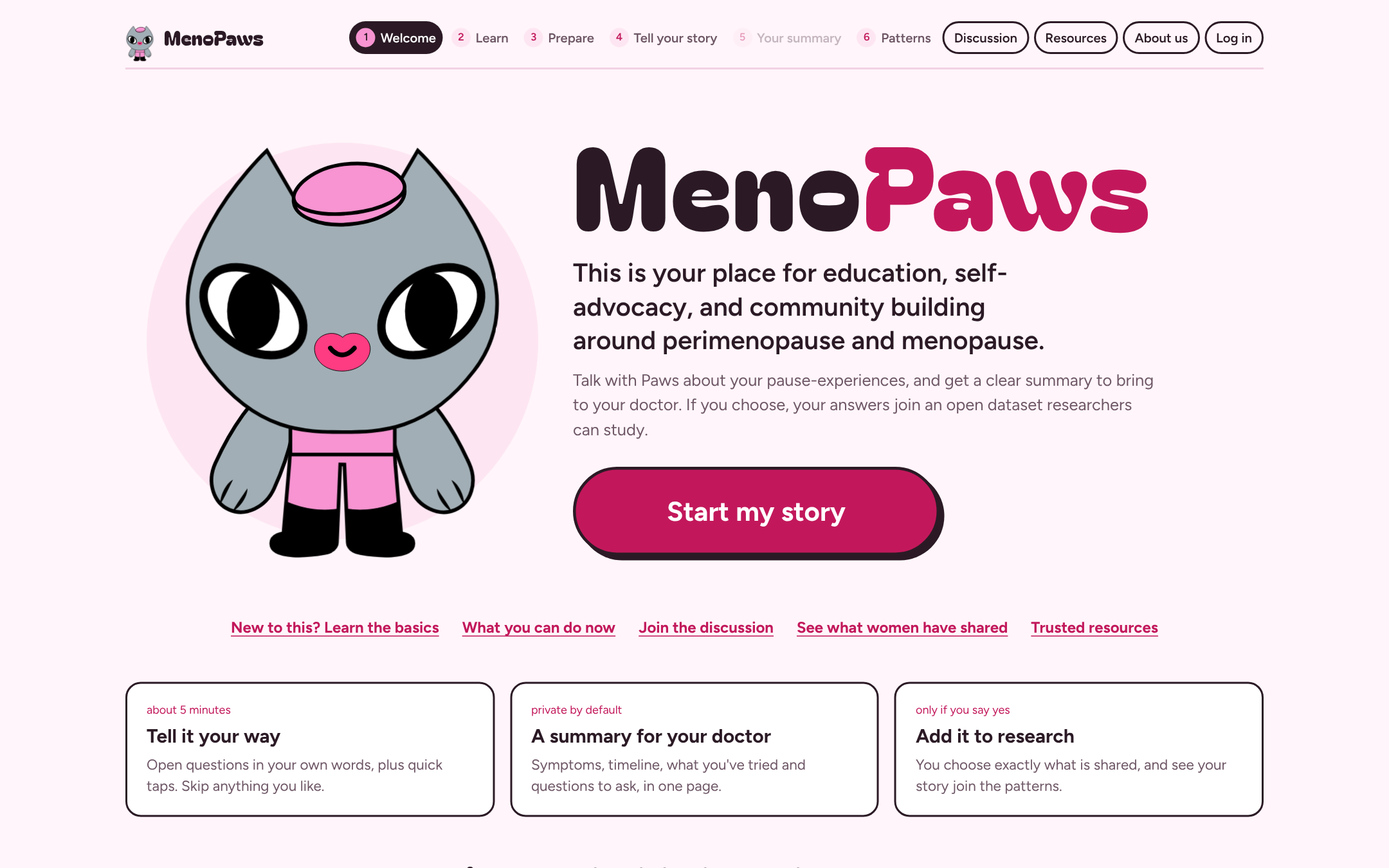
MenoPaws Homepage
The Team
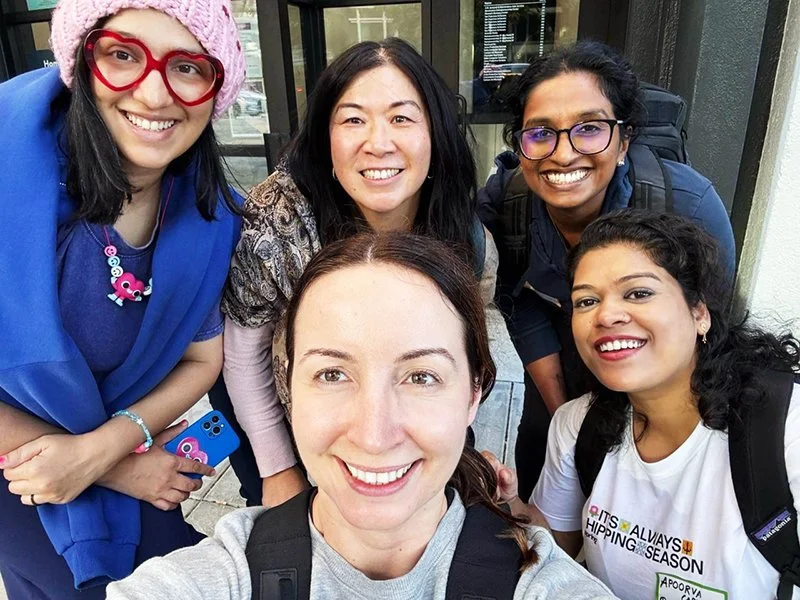
Like a well-written heist movie plot, our team had the best complimentary skills:
CRISTINA COJOCARU - Provided medical expertise for the narrative survey.
APOORVA PATIL - Led product management towards final deliverables
VANESSA LEW - Shared menopause experience for product honesty
ESHA MENON - Contributed group leadership and user testing
SONIA TIWARI - Designed the character and user experience
PAWS - Kept us cutely motivated
CLAUDE - Supported vibe coding
Background research
The problem was framed through published data, the lived experience of two team members, and the clinical expertise of a family medicine physician on the team.
WOMEN ARE OFTEN MISDIAGNOSED - 39% of US working women aged 30 to 60 felt misdiagnosed when seeking care for perimenopause symptoms, and many were treated for anxiety (33%) or depression (27%) instead (Biote Perimenopause Focus survey, 2025).
SYMPTOMS AFFECT WORK - Of 4,440 women aged 45 to 60, 13.4% reported an adverse work outcome and 10.8% missed work in the past year, an estimated $1.8 billion a year in US lost work time (Faubion et al., Mayo Clinic Proceedings, 2023).
DOCTORS FEEL UNDERPREPARED - Only 6.8% of 177 family medicine, internal medicine and OB-GYN residents felt adequately prepared to manage menopause (Kling et al., Mayo Clinic Proceedings, 2019).
SYMPTOMS LAST FOR YEARS - Frequent hot flashes and night sweats lasted a median of 7.4 years, and 10.1 years for Black women, the longest of any group studied (Avis et al., SWAN, JAMA Internal Medicine, 2015).
INFO-EXCHANGE IS DISJOINTED - Redditt threads and Facebook groups have disjointed exchange of information. A woman could offer honest experiences in a subreddit about timeline of menopause, and another woman could respond with something helpful in a sub-thread about medication. But there’s not enough large scale structured interview data that is open-access and useful about MULTIPLE experiences of the SAME woman, to understand how various BPSC (bio-psycho-socio-cultural) factors may have interacted with each other.
RESEARCH IS UNDERFUNDED - About 0.1% of the NIH research budget went to menopause-specific research in 2024 (Tufts University via Newswise, 2026).
What the subject-matter expert added - Dr. Cristina Cojocaru, a family medicine physician, pointed out that perimenopause can begin in the late 30s, earlier than most women expect, and that thyroid problems, medications and past surgeries can mimic or mask symptoms. As a result, the age bands start sooner and the survey asks about full health history for contextual awareness.
What our lived experience added - One teammate had every symptom yet was told she was not in menopause; another was misdiagnosed for two years before perimenopause and major depression were connected. Both stories shaped the first question: How can we gather structured narrative data to support further research on women’s menopausal health, while also giving them something in return? In case of MenoPaws - we expect that women like us can feel seen and heard through the narrative survey, find a guided community in clinician-moderated discussion boards, and get educated enough to self-advocate with confidence!
Landscape - Care platforms such as Midi, Evernow, Alloy, Maven and Tia offer treatment, and apps such as Balance and Health & Her offer tracking. MenoPaws was positioned beside them, not against them: it focuses on preparing for the appointment and, with consent, pooling stories as research data. Several of these services are listed in Resources. We consider this more of an ally-analysis rather than competitor-analysis.
Learning experience design
The experience was designed as a learning journey: understand what is happening, prepare for it, tell your story, then see that you are not alone.
Paws as a learning companion. Cute was chosen on purpose. A warm, slightly silly cat lowers the stress of a topic many women find embarrassing or exhausting, while the words around her stay respectful and accurate. Small cat puns ("paws whenever you need", "I'm feline proud of you") lighten the mood in easy moments without pulling attention away from the conversation. In sensitive moments such as pregnancy loss, low mood or safety at home, the puns stop and Paws simply listens.
1 Welcome
Sets the tone in one line: a place for education, self-advocacy and community building. A short "You're probably here because…" checklist lets a woman recognize herself before she types a word, which builds trust and a reason to start
2 Learn
Seven short, plain-language steps on what perimenopause and menopause are, which symptoms are common, and why they are often missed. Medical terms are always translated on first use, so no prior knowledge is assumed
3 Prepare
Practical, non-prescription steps for bones, heart, hot flashes and sleep, pelvic health and mood, ending in "Your plan" where she picks what to try. It turns information into action she controls
4 Tell your story (the core)
The heart of MenoPaws and where the most time was spent. It opens with an open question in her own words, then moves through 13 guided sections: about you, stage, symptoms, impact, life areas, reproductive history, health history, daily life, wellbeing, years of symptoms, being heard, what helped, and her wish.
This flow was tested over and over by the whole team with Dr. Cojocaru, flagging anything that felt clinical, intrusive or confusing and keeping what felt good. Multiple rounds of iteration balanced two goals: medically accurate enough to be useful to a doctor and to research, and experientially gentle enough that a woman keeps going. Examples of changes from those rounds:
Age bands start under 30, because perimenopause can begin earlier than expected
Pregnancy losses are named plainly (spontaneous or elective), with a gentle follow-up on timing
Medications, thyroid conditions, cancer and gynecological, breast or brain surgery are asked about, because they can mimic or mask symptoms
Impact and stress use 1 to 10 scales with human end labels such as "Barely" and "Completely"
Ethnicity follows current US federal categories, with optional subgroups, since symptoms differ across groups
"Nothing yet" clears other answers, so the data stays honest
A live side panel shows her words turning into tagged data, so she learns how a story becomes evidence while she tells it
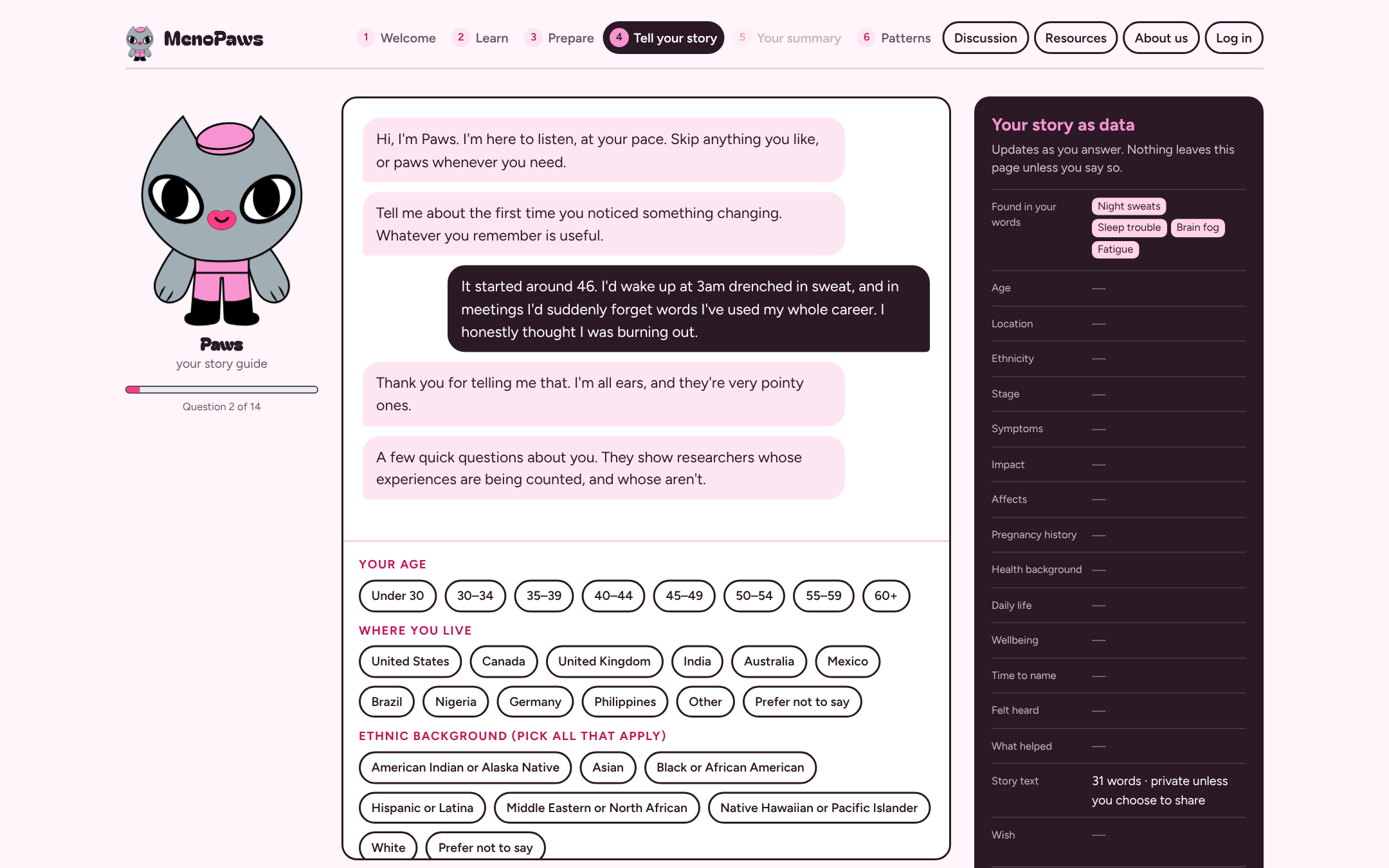
MenoPaws Tell Your Story page featuring (sample data) structured chat-based interview between Paws and a menopausal woman
5 Your summary
An editable doctor summary with her timeline, "Things to consider together" and her questions, plus a personal toolkit, helplines and a "You've got this" note from Paws. It is built to be read by a busy clinician in under a minute
6 Patterns
A dashboard of everyone's shared stories (synthetic sample data in this prototype): symptoms, ages, countries, sleep, years waited and whether women felt heard. Seeing "I'm one of many" is validating, and it shows researchers what pooled stories could reveal
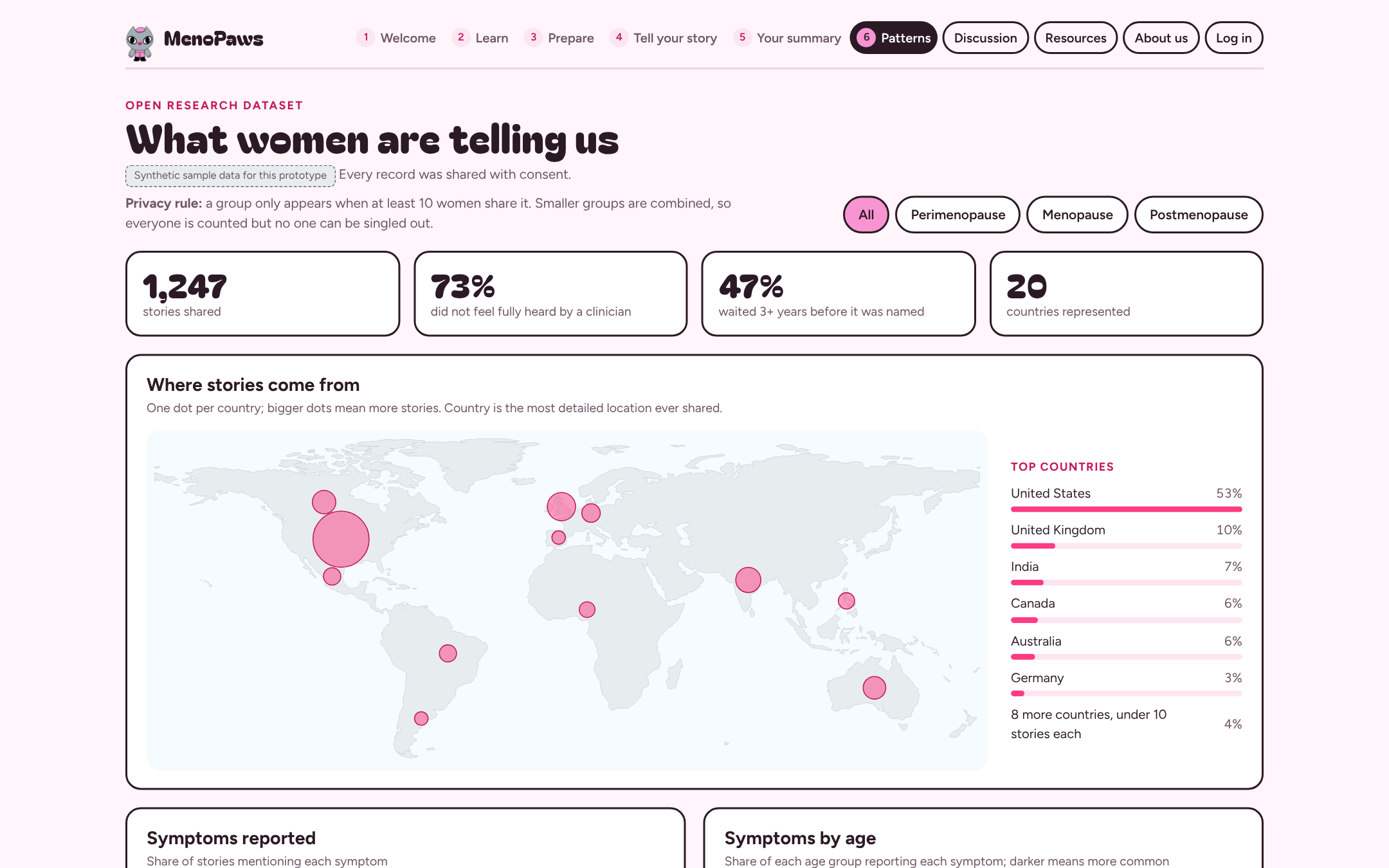
MenoPaws Patterns page
Discussion
"Paws Goss" is a community space imagined as moderated by doctors, so peer support comes with expert correction instead of misinformation
Resources
Vetted organizations, care platforms, tracking apps, research studies and helplines, grouped by need, so the next step is always one click away
About us
The team, each drawn as Paws in her own outfit, with what each person contributed. It shows that the product was built by women with lived, clinical and design expertise
Log in and profile
A demo account shows how returning visits could work: symptom check-ins over time, the next appointment and research settings. Learning continues beyond one visit
UX design
Information architecture
The main menu is a numbered six-step journey, so the order of the experience is visible at a glance. Supporting spaces sit beside it and are reachable from anywhere.
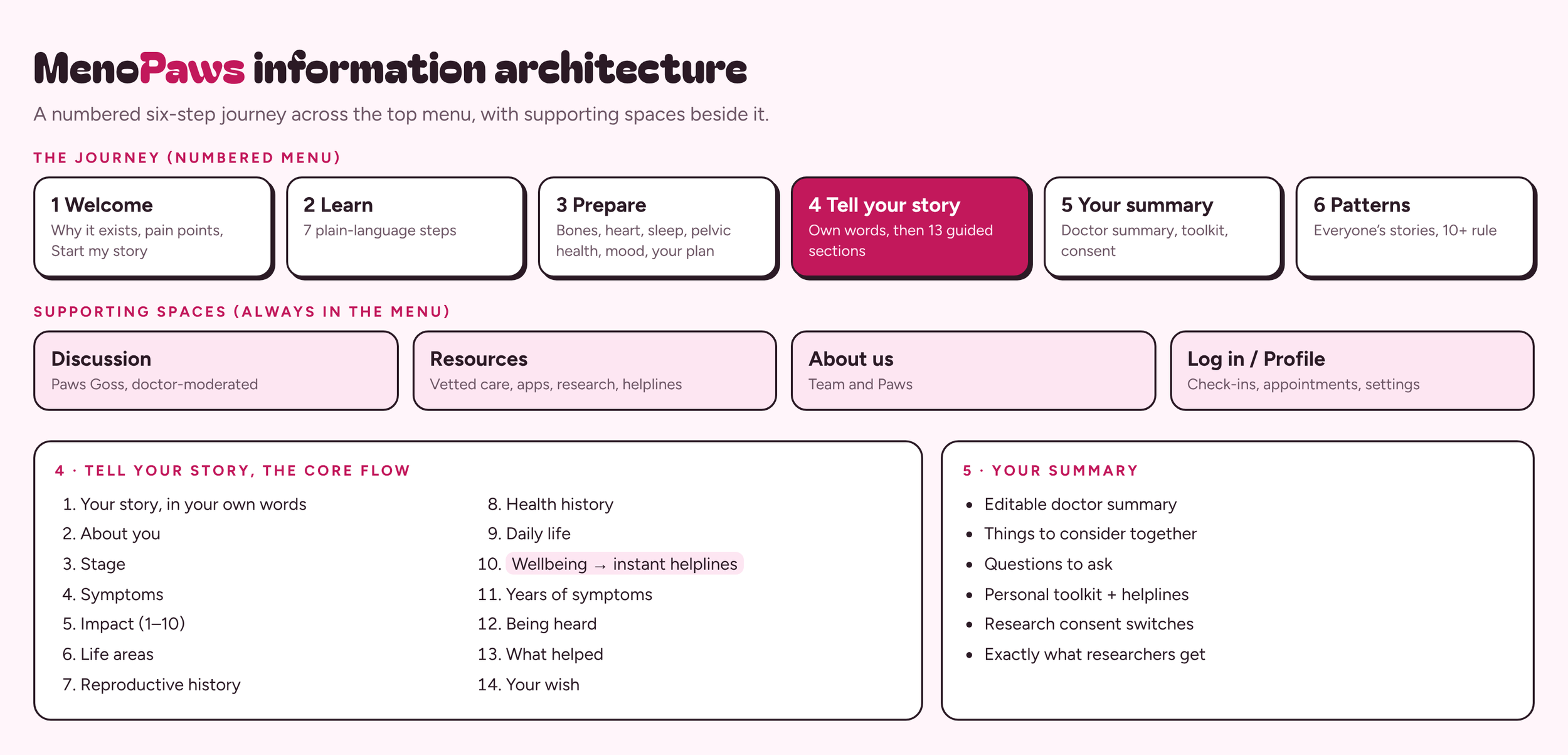
MenoPaws Information Architecture featuring how the learner journey was organized around 6 steps
Usability decisions
One clear starting point - A large, centered "Start my story" button sits directly under the one-line promise on the welcome page, full width on phones
One question at a time - The story is a conversation with Paws rather than a long form, which keeps each step small and lowers drop-off
Answer your way - Every section mixes chips for speed with an "Other" text box for anything not listed. Multi-select is used wherever more than one answer can be true
Only ask what applies - Follow-up questions appear only when relevant, such as loss timing after a reported pregnancy loss, or a medication list after "Yes"
Skip without guilt - "Prefer not to say" is offered on personal questions, and exclusive answers like "None of these" or "Nothing yet" clear the others automatically
Edit before you share - The doctor summary is fully editable, with a note encouraging her to revise anything that does not sound like her
Show the data as it forms - The side panel makes an abstract process (story to data) concrete and checkable
Demo-friendly - "Use sample answer" buttons let presenters and first-time visitors move through the flow quickly
Works on any screen - Layouts stack to one column on phones, and the menu becomes a swipeable strip
Accessible by default - Charts always write out values and labels instead of relying on color, text meets contrast guidelines, and all animation stops for people who prefer reduced motion
Trust and safety
Trust was designed into the experience, so these patterns appear wherever personal data is involved
LAYERED CONSENT - Separate switches for answers, her own words, background details and study invitations are all off by default
SHOW THE RECORD - A code-style box shows exactly what researchers would receive and updates as the switches change
DE-IDENTIFICATION NOTE - Before sharing, a note explains that names, places, dates and identifying details are removed first
NEVER SHARED - Wellbeing and safety answers, medication names, name, email and city are never shared, and this is said plainly where they are asked
10-WOMAN PRIVACY RULE - Charts show a group only when at least 10 women share it, and smaller groups are combined or shown as "<10"
INSTANT HELPLINES - Reporting low mood or feeling unsafe at home shows 988 or the National Domestic Violence Hotline right away
NOT A DIAGNOSIS - Paws helps her ask and her clinician answers, as stated in the summary and resources
HONEST LABELS - "Synthetic sample data" and "Prototype" labels appear on anything mocked
UI & Interaction design
Paws, the character
Paws is a menopausal grey cat in a pink beret and pink outfit, titled Chief Listening Officer. She was designed as a gentle guide: she listens, reacts with empathy and hands the spotlight back to the woman telling her story. Her bold outlines, big eyes and simple shapes keep her readable at any size. Conversations around healthcare can feel clinical and scary, so the character was added to the learning experience to diffuse that stigma and stress with cuteness. As noted in Sonia’s prior research about AI characters, having structured conversation patterns in service of a pre-defined learning goal is useful and does not create the obsessive conditions of parasocial interactions typically seen in the overly open-ended “I am your best friend” type deceiving chatbots.
Animated states. Paws reacts to what she hears, so symptoms feel seen rather than just recorded
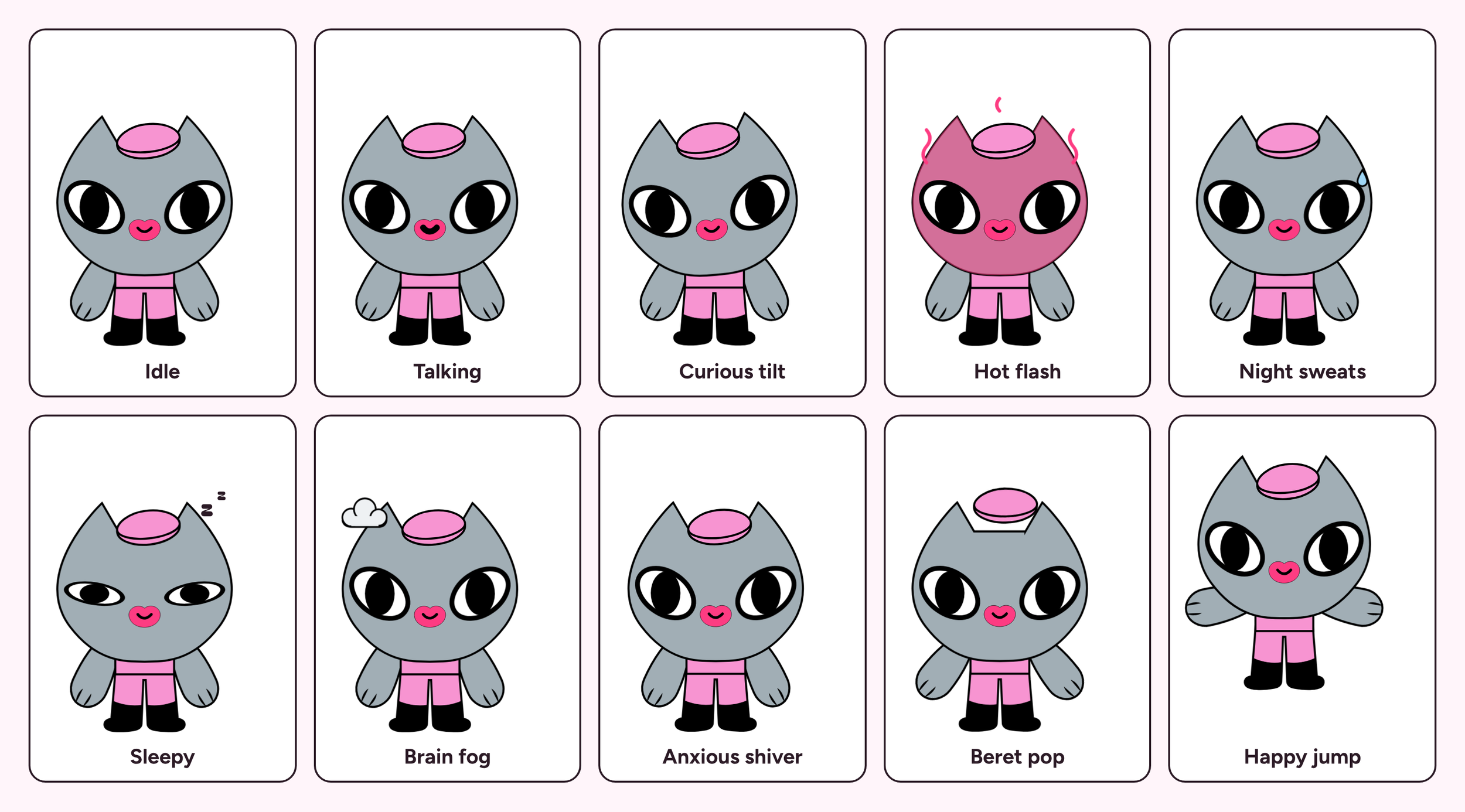
Subtle animated states of Paws to include in the six-step learner journey
WELCOME - When the app is first loaded, Paws jumps, and blinks, and one the way down from the jump releases a lot of heart emojis as a symbol of community action!
IDLE - Gentle breathing and blinks play on every screen, and on the welcome page her eyes follow the cursor
TALKING AND CURIOUS TILT - While she asks questions in Tell your story and Learn, her mouth opens and closes as she speaks and her head tilts on open questions
SYMPTOM REACTIONS - Hot flash, night sweats, sleepy, brain fog and anxious shiver play when the matching symptom is selected
BERET POP - On click, the beret hops and her arms lift and settle
HAPPY JUMP - On finishing the story, sharing with research or completing a plan, she crouches, jumps with arms out, lands softly and sends up hearts
Her arms always stay attached at the shoulders, her grey fur, black outlines and pink lips never change, and she is never used as a joke in sensitive moments
Outfit variants
Only the beret, top and pants are recolored, so every variant is still clearly Paws. Each team member has her own version on the About us page.
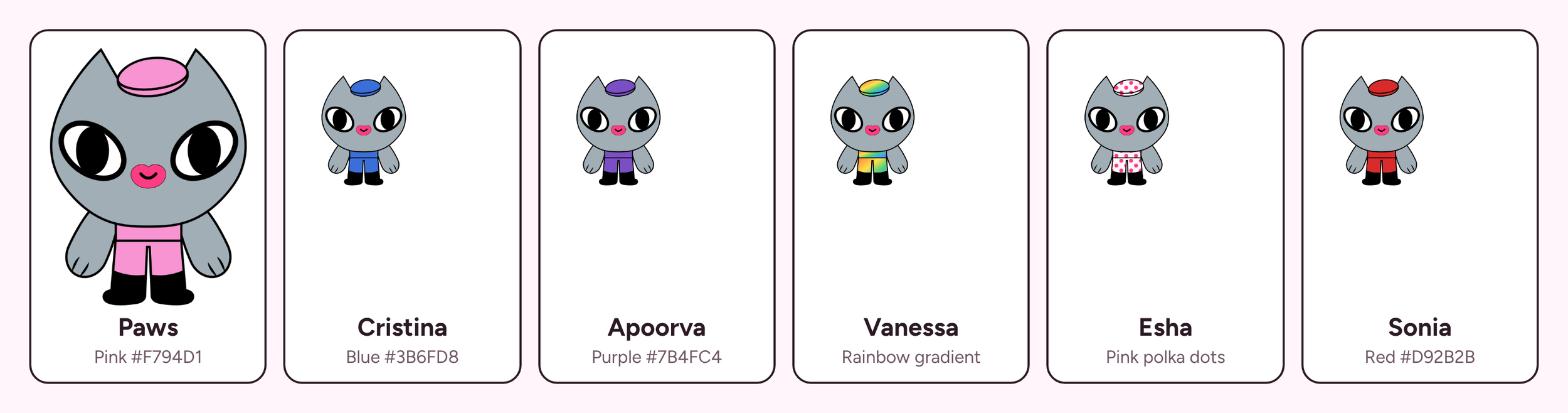
Paws color variants based on our team’s favorite colors :)
Color Palette
Pink is the color most associated with menopause awareness on social media, so the palette was built on it, grounded by a deep plum-black and Paws' grey fur.
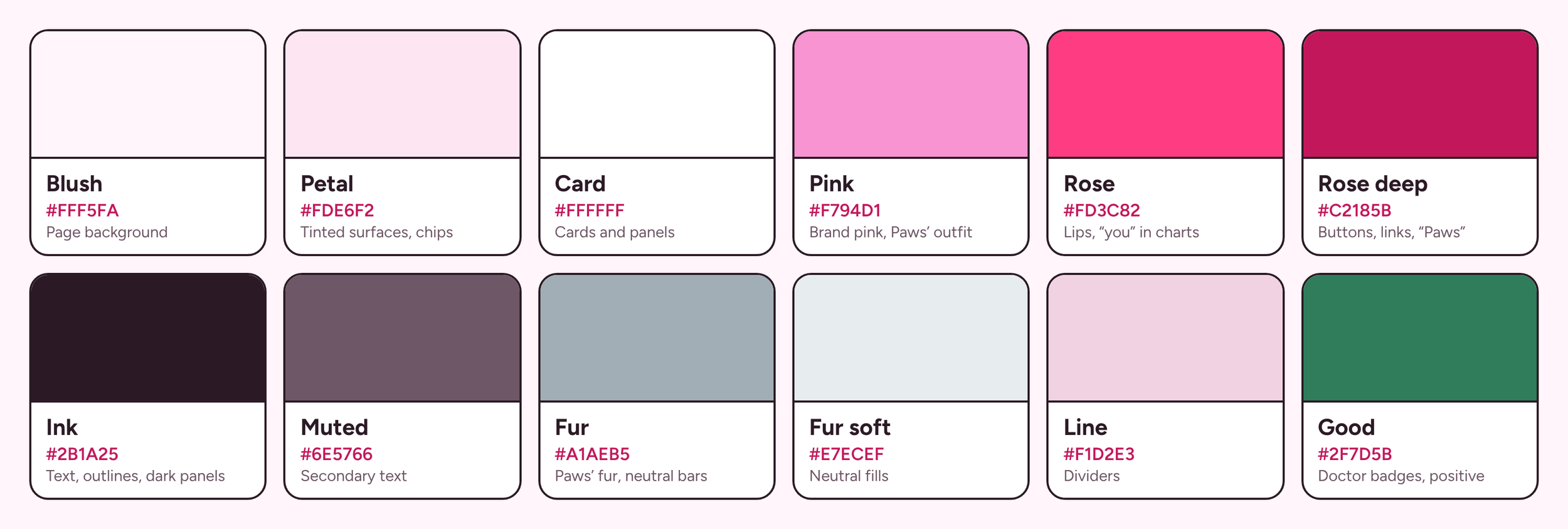
Color palette, otherwise known as that cursor-swirl in the color-gradient that Sonia obsesses about even when it’s not that important
Contrast - Body text is Ink or Muted on Blush or white. White text sits only on Rose deep or Ink, never on Pink or Rose. Charts never rely on color alone.
Typography
Two typefaces are used, both free on Google Fonts: one display face and one body face.
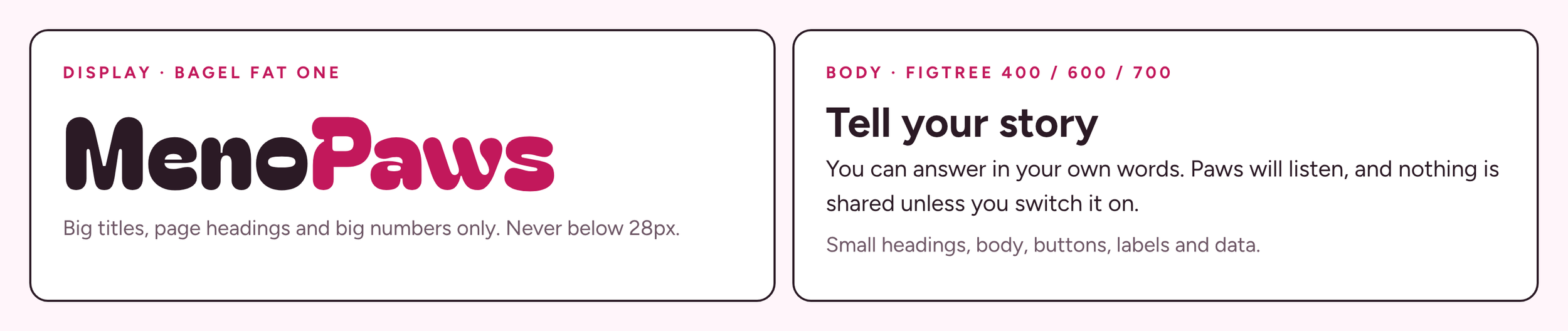
Typeface and type hierarchy, the combinations Sonia obsesses with more than wine and cheese pairings
Bagel Fat One is never set below about 28px; smaller headings use Figtree Bold
In the wordmark, "Meno" is Ink and "Paws" is Rose deep
Eyebrow labels are Figtree Bold, uppercase, letter-spaced, in Rose deep
Running text is kept near 60 to 70 characters per line
Logo
The logo pairs Paws' head with the MenoPaws wordmark. Four versions are provided: primary horizontal (website header, slides, documents), stacked (posters, square posts), icon with Paws' head in a Petal circle (favicon, profile pictures), and reverse on Ink, with "Meno" in Blush and "Paws" in Pink. Clear space around the logo equals the height of Paws' beret; the horizontal logo is never shown narrower than 120px.
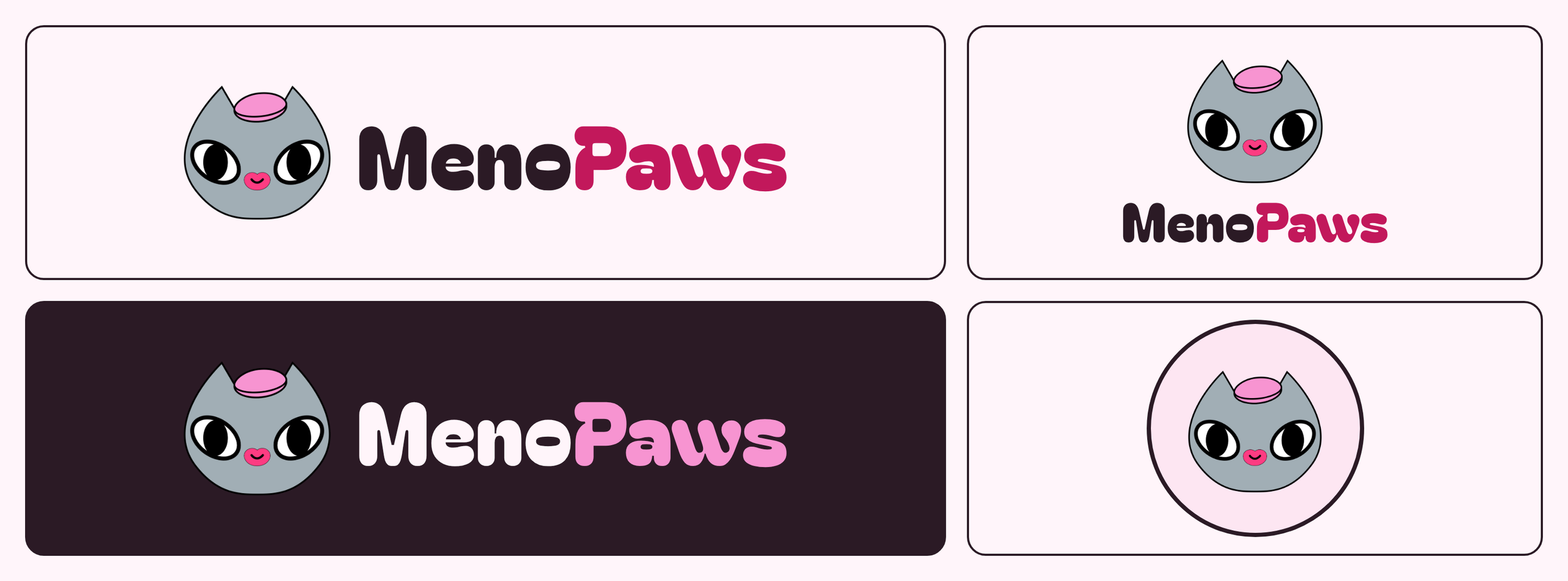
MenoPaws Logo variations - in case our work gets the attention it deserves beyond the hackathon, and turns into a movement that calls for cute merch!
Layout and components
The look borrows from Paws herself: bold Ink outlines, rounded shapes, flat color and a slight offset shadow on buttons, like a sticker. While this wasn’t super necessary for the purpose of the hackathon itself, as a designer I love creating design systems that keep the look and feel (and broader experience) consistent so that it’s ready to scale, whenever possible.
CARD - Cards are white with a 2px Ink border and a 16px radius
PRIMARY BUTTON - Buttons are Rose deep pills with white text, a 2px Ink border and a 3px offset Ink shadow that presses in on click
START MY STORY BUTTON - The main call to action uses the same style at 22 to 28px text, at least 380px wide on desktop and full width on phones
CHIP - Chips are pills with a 2px Ink border that fill Pink when selected
SCALE (1 TO 10) - Scales are ten equal chips in a row with human end labels
DATA PANEL - The story-as-data panel uses an Ink background with Pink tags
HELPLINE ALERT - Helpline alerts are light pink boxes with a Rose deep border
CHECKLIST - Checklists use round Pink check badges.
CHARTS - Charts use Fur grey for others and Rose for "you", with values written on the chart
Content is capped at 1180px wide with 16px side gutters, and sections stack to one column below 720px (helps keep it responsive across devices)
Closing thoughts from Sonia
This is by far the most fun I’ve had collaborating with new people at a Hackathon!
I’ve been to other hackathons where people bring in projects that are near-complete and pretend like it was made that day. I’ve also been to hackathons where teams are pre-formed or someone is sitting in a corner alone developing an idea without any collaboration (not the point of social hackathons!?). Given those experiences, I wasn’t expecting a lot going in. I’m glad I showed up anyway!
I’m grateful for having found four amazing women to work with (Cristina, Apoorva, Vanessa, and Esha), and genuinely improving the ideas through collaboration.
I walked in with character vector art made in Adobe Illustrator the night before, because it’s easier to embed SVGs in Claude Artifacts. I also had a very basic layout for the homepage along with a broader understanding of the problem area - all of which was encouraged by the organizers ahead of time through Discord. That on its own, wasn’t a product - just the tentative premise and a quick visual guide.
The content, narrative survey, resources to include, feedback from user testing etc. was all done in real time, added through collaborative effort during the hackathon. It felt like being part of a hive-mind (a less creepy version of Apple TV’s Pluribus). I felt connected with the collective intelligence of the group - and feel proud of what we built together!
If you are a founder or investor in healthtech and would like to
help make MenoPaws a reality, let’s connect on Linkedin!
